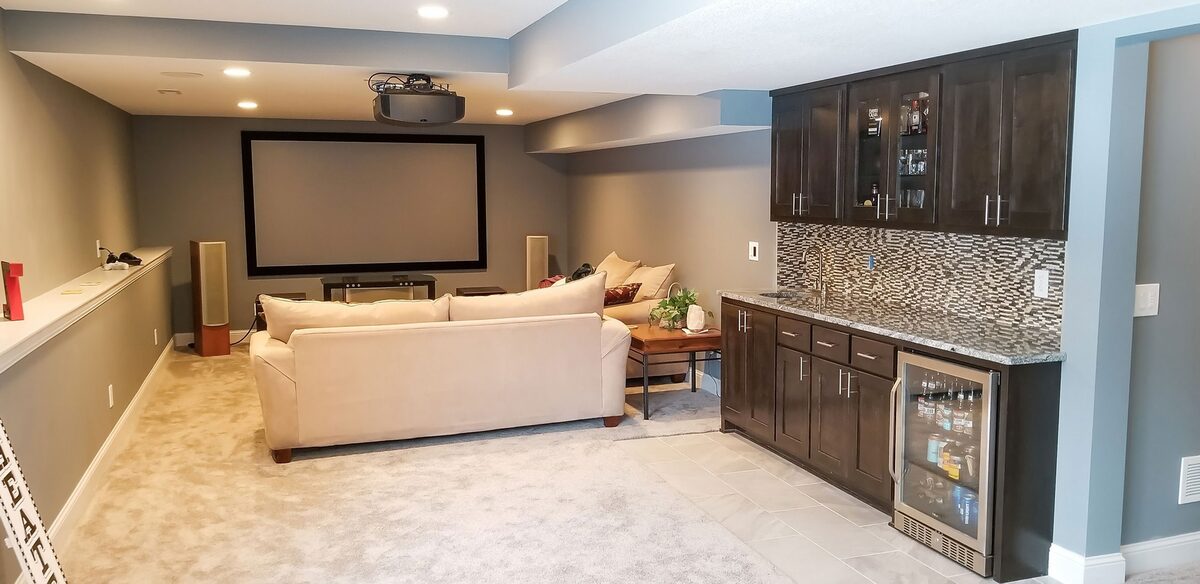
- Family rooms with theater, media, or projector scope
- Wet bars, beverage centers, and entertaining spaces
- Guest suites with full bath and storage
- Home offices, fitness rooms, and golf simulators
- Real storage that doesn't end up in the corner
Basement finishing that feels like part of the house, not a bonus room.
A finished basement should feel like more house, not extra square footage. We plan lower levels as real living space, with circulation, comfort, light, and storage built in from day one.
Sight lines, ceiling rhythm, mechanical routing, lighting, and storage have to be planned together. The lower levels that feel like another floor of the house, not a finished afterthought, are the ones where those decisions were made up front, not stacked one at a time after the framing was already up.
Why basements underperform
The ones that fall short usually got planned as leftover space.
A strong basement remodel treats the lower level like part of the main house. That means resolving comfort, ceiling, mechanical, sound, and storage before finishes are touched. The basements that disappoint are almost always the ones where finishes drove the project and the structural conditions got patched around.
Temperature, air quality, and acoustics matter more downstairs.
Basements feel dramatically better when HVAC routing, insulation, and sound control are handled like core decisions, not hidden afterthoughts. The wrong supply register location can ruin a $30,000 theater build.
The room mix should match how the family actually uses the level.
Entertainment, guest space, fitness, office use, and storage all place different demands on lighting, privacy, and circulation. Lumping them together usually compromises all of them.
A better basement hides more than it shows.
Good lower levels solve the storage problem the family already had upstairs. That usually means dedicated, well-lit, accessible space — not the awkward corner left over after the family room got drawn first.
Scope and budget orientation
What a Twin Cities basement finish actually costs.
The right number depends on how much of the lower level needs to become real living space and what condition it starts in. The ranges below cover construction-side cost and typically exclude furniture, theater equipment, and the work moisture or mechanical issues sometimes require before finishing starts.
Family room, full bath, real lighting plan.
Drywall, ceiling, flooring, electrical, lighting, and a clean full bath. Often $80,000 to $140,000 in the Twin Cities depending on bath fixtures and finish level.
Family + wet bar + bath + guest or fitness room.
Larger finished area with bar cabinetry, beverage appliances, more involved millwork, and a thoughtful guest or fitness zone. Often $140,000 to $260,000.
Theater, sport, deep millwork, structural work.
Custom-built theaters, sport courts, sauna or spa rooms, deep cabinetry, structural changes, or significant moisture remediation. Often $260,000 to $500,000 or more.
Where the work fits
Basements deserve more pre-construction time than they usually get.
The pre-construction pass is where a basement project earns its quality. The four issues below are what we work through before drawings start hardening — in any house, in any neighborhood, in any era of construction.
Solve the water problem before the finish problem.
Vapor strategy, perimeter drainage, sump capacity, and grading at the foundation matter more than any finish decision. We diagnose what the basement is doing and design around it — not over it.
Ductwork and beams set the ceiling everywhere else.
The lowest point in the room is usually a duct, beam, or main drain. We plan around those before drywall layout because soffit choices change the entire room's feel.
Sleeping rooms have non-negotiable requirements.
If any room downstairs is meant for sleeping, egress windows, smoke and CO protection, and ceiling height all need to meet code. We confirm what the basement can legally support before assuming bedroom layouts.
Basement finishing FAQ
Questions homeowners ask before the project starts.
The most useful early questions are usually about the conditions the basement starts in, not the finishes that go in last.
What does basement finishing cost in the Twin Cities?
A simpler basement finish often runs $80,000 to $140,000. A full family lower level with a wet bar, full bath, and theater area usually lands $140,000 to $260,000. Premium lower-level work with sport courts, custom millwork, or major moisture and mechanical corrections can reach $260,000 to $500,000 or more. The cost guide below has the breakdown.
What should be checked before finishing a basement?
Moisture and drainage condition, true ceiling height under beams and ducts, egress for any sleeping rooms, mechanical layout, electrical capacity, and bathroom rough-in feasibility. Those have to be honest before finish selections drive the design.
Can a basement become legal sleeping space?
Often, but it depends on egress, ceiling height, smoke and CO protection, and emergency exits that meet code. We help homeowners review what the basement can legally support before the layout assumes it.
How long does basement finishing take?
A typical Twin Cities basement finish runs 12 to 20 weeks of construction once permits and selections are locked. Bathroom rough-in, custom millwork lead times, and inspection scheduling are usually what move the date.
Do you handle moisture problems before finishing?
Yes. Moisture, drainage, odor, staining, or seepage need to be solved before framing and finishes go in. Finishing over those problems creates hidden damage and expensive rework, so we plan that work into the project up front.
Next step
If the lower level should become real living space, the planning conversation is where it starts.
We can help pressure-test scope, ceiling and moisture conditions, and budget category before drawings get expensive to change. The cost guide below covers what most Twin Cities homeowners want to know first.