The full basement service
How we run basement finishing.
Pre-construction inspection, room-mix planning, theater and bar work, custom millwork. The service page covers the full approach.
Basement FinishingPlymouth is home base. We’ve been working out of 15500 9th Ave N since 1974, which means most Plymouth basements we finish are familiar territory: the housing stock, the drainage patterns, the inspectors, and the trade partners we’ve worked with for decades. The basement project lives or dies on what’s behind the drywall, not in front of it.
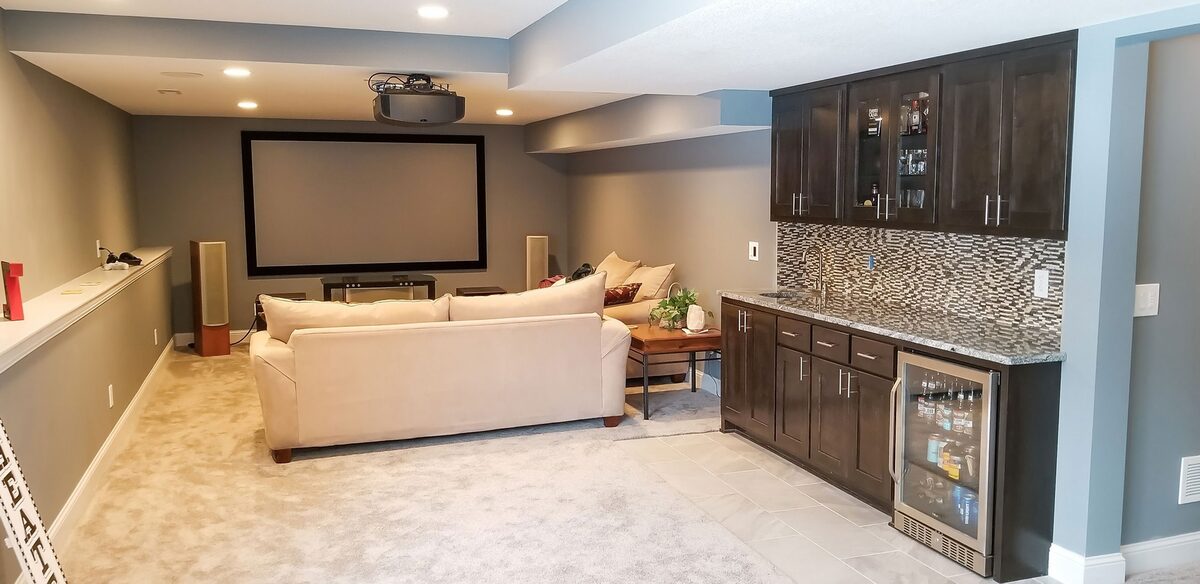
The Plymouth basement project
A Plymouth basement project almost always starts with the same five-condition walk. Moisture history: where has water been, where might it go again, what does the existing sump and drain-tile setup actually do? Ceiling height and beam rhythm: an 8-foot ceiling finishes very differently than 6′10″ under ducts. Mechanical layout: HVAC trunks, water-heater clearance, electrical panel access, plumbing rough-ins for an added bath. Egress and code compliance: bedroom egress windows, stair handrails, smoke and CO requirements. Structural condition: foundation cracks, sill plates, joist health.
If anything in that walk comes back yellow or red, the right move is to address it before finishes get planned. A finished basement built over a moisture problem is now a problem hidden behind drywall. A theater designed around a soffit run that wasn’t mapped is a sight line that can’t move without rework. The pre-construction inspection isn’t looking for reasons not to finish. It’s scoping the project honestly.
Once the conditions are clear, the room mix can be planned together rather than stacked into leftover space. Plymouth basements often have the square footage to handle several uses: family room, theater, wet bar, guest suite, fitness, office, storage. The mix only works if traffic, sight lines, sound isolation, and mechanical access are agreed on before millwork drawings happen.
Investment ranges
Most Plymouth lower-level projects land $100,000 to $260,000. Simpler family-room finishes can come in lower; theater builds, wet bars, custom millwork, specialty rooms, and moisture or mechanical correction work move the number higher.
Newer Plymouth homes from the 1990s through current builds usually have unfinished lower levels with good ceiling height, modern drain-tile systems, and mechanical layouts that finish cleanly. Older Plymouth homes around Medicine Lake, Bass Lake, and the older residential pockets may need moisture correction, sump-pump upgrades, or egress framing before finish work makes sense. The cost shape is different, and the early walk tells us which path the project is on.
The local-builder advantage matters more on basements than on most other scopes. We know which neighborhoods have which water-table issues, which inspectors are running which checks, and which trade partners do the underground correction work well. That familiarity reduces surprises. It is the entire point of hiring a Plymouth builder for a Plymouth home.
Useful next pages for Plymouth basement planning
If you’re scoping a Plymouth basement, these pages cover the rest of the relevant context.
For a regional lower-level example, see our Twin Cities Finished Basement. Use the finished rooms to discuss the spaces you want, then compare them with the moisture, ceiling and mechanical conditions in your own basement.
Pre-construction inspection, room-mix planning, theater and bar work, custom millwork. The service page covers the full approach.
Basement FinishingBeyond just basements. What we see across kitchen, bath, addition, and whole-home projects in our home market.
Plymouth Service AreaA deeper look at the cost drivers, tier definitions, and what each range typically buys across the Twin Cities.
Cost guidePlymouth basement questions we hear often
Most Plymouth lower-level projects land $100,000 to $260,000. Simpler family-room finishes can come in lower; theater builds, wet bars, custom millwork, specialty rooms, and moisture or mechanical corrections move the number higher. Newer homes with unfinished space and modern drainage usually run cleaner than older homes that need correction first.
Moisture history, drainage, sump capacity, ceiling height, beam rhythm, mechanical layout, egress requirements, and structural condition. If any of those come back yellow or red, address them before drywall planning, not after.
Most newer Plymouth homes have decent ceiling height, modern drain-tile systems, sump pumps, and mechanical layouts that finish cleanly. Older Plymouth homes, especially around Medicine Lake and Bass Lake, may need moisture correction, drain-tile updates, or egress framing before finish work makes sense. The pre-construction inspection sorts that out.
A finished basement that gets the room mix right reads like a real floor. One that doesn’t reads like a basement with nicer finishes. Theater, bar, guest suite, fitness, office, play, and storage all need traffic, sight lines, sound isolation, and mechanical access agreed on before millwork lands.
Next step
Start with the pre-construction walk. We can come out, look at the conditions, and tell you honestly what the basement can carry before drawings get expensive.