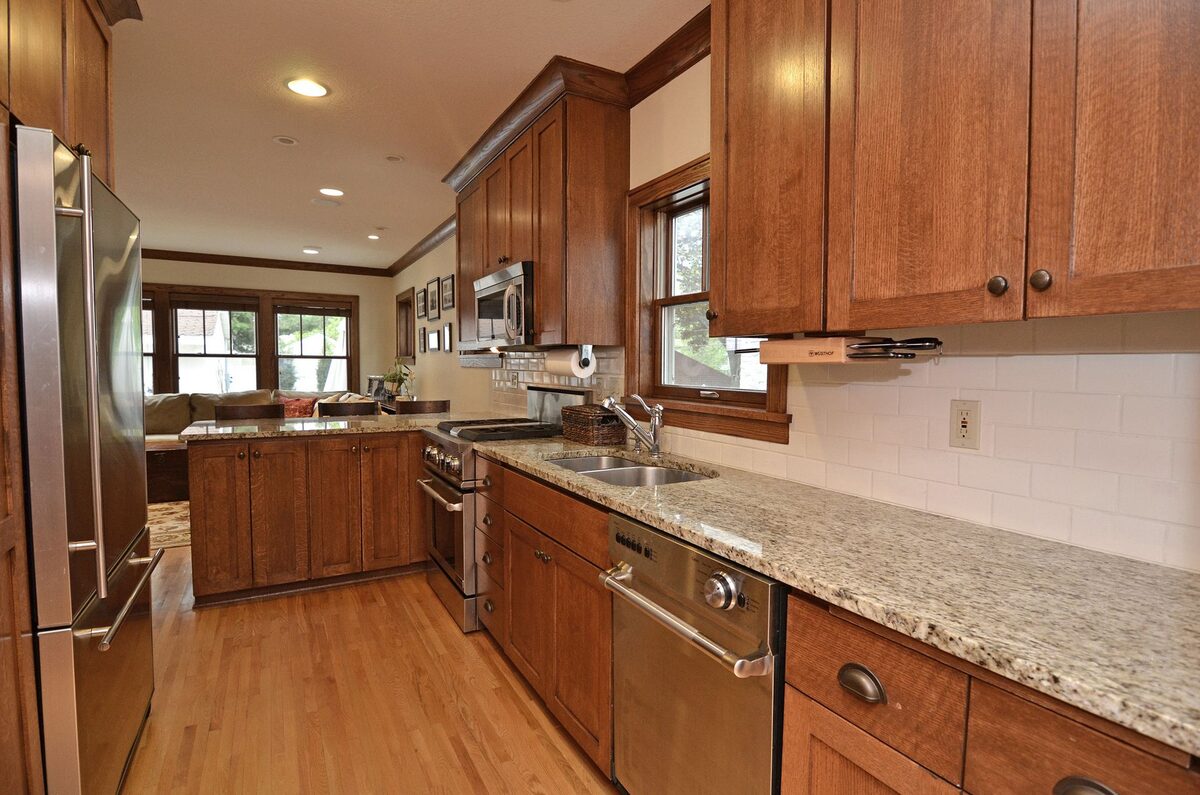
Whole-home renovation is the hardest project type to price from the outside, because the number depends less on square footage than on how much of the house's logic you are willing to change. Two Minneapolis houses with the same footprint can land $700,000 apart based on structure, mechanicals, and how far the finish work reaches. The ranges below exist to put your project in the right category before anyone starts designing it.
Whole-home renovation planning ranges
These are planning ranges, not bid promises. Where your house lands depends on its age, its systems, and how much of the layout is changing.
| Project type | Typical planning range | What it usually includes |
|---|---|---|
| Focused renovation | $400,000-$800,000 | Main living levels reworked: kitchen, primary spaces, key baths, finishes unified, targeted systems updates. Layout improves; the footprint mostly holds. |
| Comprehensive renovation | $800,000-$1.5M | Most of the house: full layout rework, all baths, mechanical and electrical brought current, insulation and windows addressed, finish continuity everywhere. |
| Extensive renovation | $1.5M-$3M+ | Structural reconfiguration, additions, full systems replacement, and top-tier finish work. The house is effectively rebuilt around its best bones. |
The house is one system, and that is where the money goes
Room-by-room remodels get to ignore what is behind the walls they don't open. A whole-home renovation does not. Once the house is open, the wiring, the plumbing, the ductwork, the insulation, and the framing are all on the table, and the honest move is to fix them while they are exposed. That is a real cost. It is also the entire difference between a house that was renovated and a house that was decorated. When you compare whole-home numbers against a stack of single-room quotes, you are comparing two different products.
Systems and structure set the tier, finishes fill it in
The jump from one planning tier to the next is rarely about tile. It is about whether bearing walls move, whether the stair relocates, whether the service panel and HVAC get replaced, and whether an addition enters the plan. Finish level matters; custom cabinetry and stone reach through every room of a whole-home project, not just one. But structure and systems decide which table row you are in. Settle those questions first and the finish budget becomes a choice instead of a surprise.
What older Minneapolis homes add to the number
Much of Minneapolis was built before 1950, and those houses carry predictable conditions: knob-and-tube wiring, galvanized supply lines, marginal service capacity, uninsulated wall cavities, and foundations that have opinions. None of this should scare you off. These are often the houses most worth renovating. But the budget should assume some of it is there, because finding it mid-project without contingency is how renovations turn adversarial. If your house is in Linden Hills, Fulton, or anywhere south of 50th, plan for the era, not just the floor plan.
One pull or phased: the cost of doing it twice
Spreading a whole-home renovation across several phases can make the cash flow easier, and for some families that is the right call. It is not the cheaper call. Phased work typically runs 10 to 20 percent more in total, because mobilization, dust protection, and tie-in work get paid for every phase, and earlier finished work has to be protected from later construction. We walk through this tradeoff in detail in our phasing guide for older Minneapolis homes.
- One coherent project means systems, structure, and finishes get decided once, by one logic.
- Phasing buys cash-flow flexibility at a real total-cost premium.
- Whatever the sequencing, the design should be whole-home from day one, even if construction is not.
If you are weighing renovation against selling and buying, the comparison deserves its own math. We wrote it up in renovate or move. For most families in houses they like, on lots they like, the renovation wins. But it should win on numbers, not sentiment.
Common whole-home cost questions
What does a whole-home renovation cost in Minneapolis?
Most projects we would plan responsibly land $400,000 to $800,000 for focused scope, $800,000 to $1.5M for comprehensive scope, and $1.5M to $3M+ when structure, additions, and full systems replacement are in. Lighter selective renovations can start near $300,000.
Why not just get quotes room by room?
Because the rooms share walls, systems, and a budget. Room-by-room quotes each carry their own mobilization and none of them owns the house-wide questions, which means you pay for the overlap and nobody is accountable for the whole.
What is the contingency on a whole-home project?
For pre-1950 housing stock we want a real conversation about contingency before contracts, not after demo. The exact figure depends on what the house lets us verify up front. A whole-home budget with no contingency is a plan to be surprised.
Can we live in the house during a whole-home renovation?
For focused-scope projects, sometimes, with honest conversation about what that does to daily life and schedule. For comprehensive and extensive projects, moving out is usually the better decision for the family and the project both.
Official planning references
Whole-home projects in Minneapolis run through city permitting and inspections at multiple points. These are the starting references before any project-specific review.
Whole-home planning
Find out which tier your house is actually in.
Send us the short version of what you're considering. Andy reads every request personally and writes back within a business day, usually with the questions that will sharpen the plan before anyone draws it.